
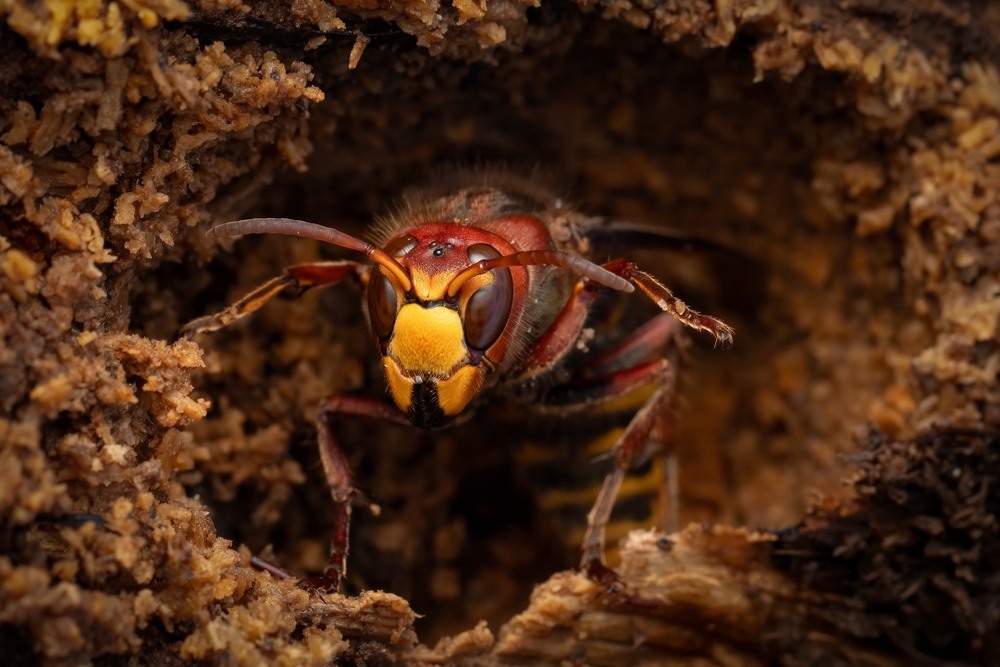
A large, heavy-bodied hornet circling your porch light or thumping against a window after dark is most likely a European hornet. This established Mid-Atlantic species continues flying at night and is readily drawn to bright exterior lighting.
In Washington, D.C., Maryland, and Northern Virginia, the insect is often mistaken for an invasive giant hornet. In most cases, however, a hornet at the light is a foraging worker rather than proof of a nest inside the home. Steady traffic through the same wall opening, soffit gap, attic vent, or tree cavity is the more meaningful warning sign.
The Night-Flying Hornet Is Usually a European Hornet
The European hornet, Vespa crabro, is one of the largest social wasps commonly encountered in the eastern United States. Adults are about an inch long, with a reddish-brown head and thorax, reddish-orange wings, and a mostly yellow abdomen patterned with brown markings. Their thick bodies and powerful flight make them look and sound more imposing than yellowjackets or paper wasps.
Nighttime behavior is one of the clearest identification clues. According to Virginia Tech’s European hornet identification guide, European hornets are attracted to bright lights and may repeatedly strike windows and screens after dark. A homeowner may hear the impact before seeing the insect.
That behavior can look aggressive, but a hornet circling a fixture is not necessarily trying to attack. Workers away from the nest are usually focused on foraging. They are more likely to become defensive when trapped, struck, sprayed at close range, or encountered near an active colony.
Why European Hornets Circle Porch Lights at Night
European hornets remain active after sunset, which brings them into contact with porch lights, floodlights, garage fixtures, and illuminated windows. Once attracted, a hornet may circle the bulb, land on nearby siding, or repeatedly collide with glass and screening.
Exterior lights also gather moths and other insects. Because European hornets prey on insects, a well-lit porch can become a concentrated feeding area. Even when prey is not obvious, the brightness itself can keep a hornet near the fixture.
Claims that hornets confuse porch lights with the moon are common, but the extension guidance used for this article documents the attraction without establishing that explanation. The practical conclusion is simple: bright nighttime lighting can increase European hornet activity around doors, windows, decks, and patios.
Why European Hornets Are Common Around DMV Homes
European hornets are not unique to the DMV, and they are not native to the region. They were introduced to North America in the nineteenth century and are now established across much of the eastern part of the continent. The Washington metropolitan area provides many of the protected nesting sites and wooded habitats they use.
Hollow trees, sheds, porch roofs, attics, and wall voids can provide nesting cavities. Activity becomes more visible as summer progresses because each colony begins with a queen in spring and grows as workers are produced. By late summer, a mature colony may contain hundreds of hornets, so more workers are moving through the landscape after dark.
The NC State guidance on wasps at porch lights notes that European hornets can travel a considerable distance from their nests. A single visitor may have come from a neighboring property or wooded area, so porch-light activity alone does not confirm a nest on your property.
How to Tell a European Hornet From Similar Wasps
Size alone is not enough for reliable identification. Several Mid-Atlantic wasps are large, and poor lighting can obscure their markings. Color, nesting behavior, flight time, and body shape provide better clues.
| Insect | Key Identification Clues | Typical Nesting Site | Porch-Light Relevance |
| European hornet | Reddish-brown head and thorax; yellow abdomen with brown markings | Hollow trees and structural cavities | Most likely large hornet repeatedly flying around lights after dark |
| Bald-faced hornet | Mostly black with white facial and body markings | Visible gray paper nests | May appear near lights, but is less associated with nighttime activity |
| Cicada killer | Very large, dark body with yellow abdominal markings | Individual burrows in dry soil | Usually seen near ground burrows |
| Yellowjacket | Smaller, compact body with yellow-and-black banding | Ground or structural cavities | More often noticed around food and trash |
| Northern giant hornet | Very large body with a broad orange head | Not established in the DMV | Local reports are more likely to involve established wasps |
European Hornets Versus Bald-Faced Hornets
European hornets have reddish-brown and yellow coloring. Bald-faced hornets are black and white and usually build visible aerial nests. Despite their common name, bald-faced hornets are not true hornets in the genus Vespa.
European Hornets Versus Cicada Killers
Cicada killers are solitary ground-nesting wasps. They can look as large as European hornets, but they are usually seen flying low over lawns, garden beds, or bare soil where females excavate burrows.
Does Porch-Light Activity Mean a Nest Is Nearby?
An occasional hornet at the light is not enough to locate a nest. Workers may arrive from different directions, remain briefly, and disappear when the fixture is switched off. That pattern is consistent with individual foragers moving through the area.
A nearby nest becomes more likely when hornets follow the same route repeatedly. During daylight, observe from a safe distance and look for workers entering and leaving one opening in a soffit, wall, attic vent, shed, hollow post, porch roof, or tree cavity. Consistent two-way traffic is far more meaningful than random circling around a bulb.
Hornets appearing inside living spaces or buzzing within a wall or ceiling may also indicate a structural nest. Do not seal a suspected entrance while the colony is active. Blocking the opening can trap hornets inside and encourage them to search for another route into occupied rooms.
What to Do When Hornets Gather Around a Porch Light
Start by reducing the attraction. Turn off the light when you can do so without approaching the hornet, close nearby doors, and give the insect time to leave. Avoid swatting at it or spraying upward while standing beneath the fixture.
Close curtains or blinds if indoor lighting is drawing hornets toward windows and glass doors. Repair torn screens, worn door sweeps, and gaps around frequently used entrances so insects outside cannot easily get indoors.
Motion-activated lighting can reduce the amount of time a bright fixture remains on. Yellow exterior bulbs may also attract fewer nighttime insects than bright white bulbs, although no bulb should be treated as a guaranteed repellent. Where practical, place lighting away from doorways and seating areas.
Keep children and pets away until activity subsides. Foraging European hornets are generally less defensive than workers protecting a colony, but close contact still creates an avoidable sting risk.
When a Hidden Hornet Nest Needs Professional Attention
Professional inspection is appropriate when hornets repeatedly enter an occupied structure or nest close to a doorway, deck, walkway, play area, or other frequently used space. Concealed nests in attics, wall voids, soffits, and porch roofs can be difficult to locate and unsafe to approach.
The University of Maryland overview of European hornets confirms that this species is established throughout Maryland and commonly uses protected cavities for nesting. That habit can make a colony harder to assess than a visible paper nest hanging from a branch.
Help is also advisable when hornets are appearing indoors, the entrance is inaccessible, someone has a known sting allergy, or the species cannot be identified confidently. Do not open a wall or disturb a cavity without knowing where the colony is located.
For help with persistent hornet activity in Washington, D.C., Maryland, or Northern Virginia, Pest Services Company can help determine whether you are seeing occasional foragers or signs of an active nest. Use the contact page to request professional assistance when hornets are entering the structure, gathering near a high-traffic area, or creating a concern around your home or business.
European hornets at night are a familiar late-summer sight across the DMV. In many cases, the porch light is the attraction and the building is not the nesting site. When workers repeatedly travel into the same cavity, that organized traffic is the clearest reason to investigate and address the colony safely.